
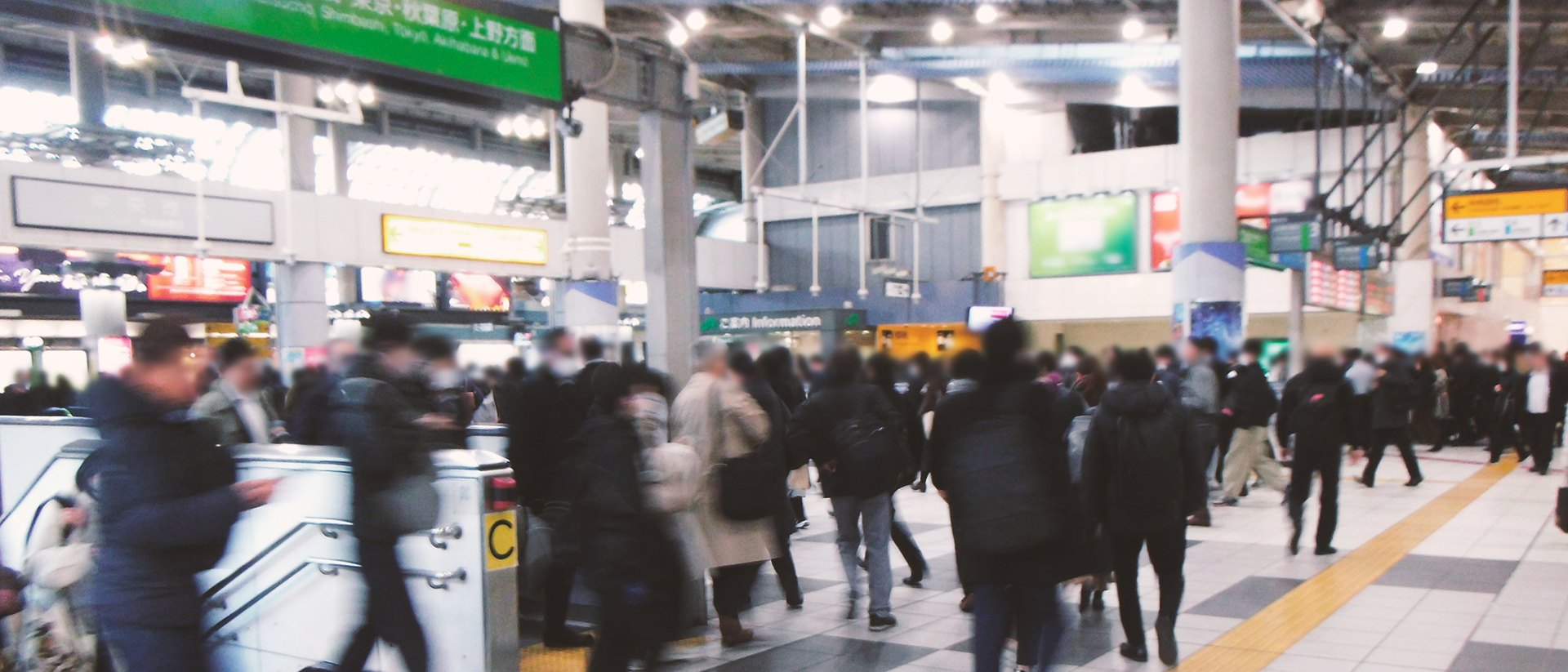
Have you ever been on a Tokyo train at rush hour?
If you come to Tokyo as a visitor and happen to take the subway on a weekday morning, the density may surprise you. On the major lines in the Tokyo area, the average congestion rate at the morning peak reached 143 percent in fiscal 2025. In practice that means the distance between one person and the next has more or less stopped existing. Some people watch a train pull in, decide against it, and wait for the next one, which arrives two minutes later just as full.
There are reasons for this that have nothing to do with anyone standing on the platform. Japan is a small country and most of it is mountain, so the land you can actually build a city on is narrower than it looks on a map. In the Tokyo area people commute by train rather than by car. The trains run constantly from early morning, and still there are hours when they cannot carry everyone.
I am one of those people: an office worker riding one of the busier lines in from a suburb outside central Tokyo.
What I find strange is how quiet the carriage is.
With this many bodies pressed together you would expect noise, and there is almost none. A small child, sometimes. Two friends exchanging a few sentences quietly, then stopping. Most people are looking at a phone. Someone has a book open and is holding it at an angle so as not to touch the person beside them. Someone has their eyes closed. Almost everyone is wearing earphones.
Japanese has a set of expressions built around the word kuuki — air. To read the air. To disturb the air. The air is bad. We spend a fair amount of our lives noticing the mood of a room and adjusting ourselves so as not to stand out in it. That is as far as I want to go with national character; the subject gets unreliable very quickly.
But the effect in a crowded train is real, and it is this: the bodies are close and the people are not.
That is the part I keep thinking about. Not being alone — becoming alone. There is a difference. The carriage is not quiet in the sense of silent. It is not empty. Nobody would call it comfortable. And yet for fifteen or twenty minutes almost everyone in it has gone somewhere private.
I do the same thing. I put in my earphones and start something without words.
The music doesn’t remove anything. The wheels are still there under the floor. The announcement for the next station still comes through, and the transfer information after it, and the chime before the doors close. What changes is the distance. The music puts a thin membrane between Tokyo and me. Everything is still audible. It is just a little further away.
It has to be instrumental. I have tried it the other way and it doesn’t work for me. A lyric is language, and language goes to the same place in my head that reading goes, and thinking, and writing. Two voices end up competing for the same room. Without words what remains is rhythm and texture and a certain amount of air, and none of it asks anything of me. The music stops being the thing I am listening to and becomes the room I am listening in.
Which makes me suspect that what concentration needs is not silence.
A silent room is not always easy to work in. Every small sound becomes an event — a chair, a cough, a notification somewhere behind you. In the carriage there is plenty of sound and plenty of information and a great many people, but almost none of it is addressed to me. Nothing is waiting for my reply. That turns out to be a good condition for thinking.
Tokyo is not a quiet city. It was never going to be. But there is a small stillness inside the noise, and a private hour inside the crowd, and both of them are available on an ordinary weekday morning if you know how to find them.
In a few minutes we reach the next station, the doors open, and I am carried back into the flow of people on the platform. Until then I would like to stay a little longer in the quiet inside my earphones.
If you want something for that stretch, 10AM by the Window runs about twenty-five minutes, which is roughly one commute.
From Tokyo, for quiet hours.